
 by Carol Phelps, Middleton Community UCC
Some points to consider:
1) Uranium is not as abundant as sunshine
2) Uranium is not a renewable or inexhaustible source of power, like sunshine is (our sun will still be shining literally billions of years from now; while there is a finite amount of uranium on our planet)
3) Like fossil fuels, uranium is an extractive technology which results in the “haves”, and the “have-nots”; it is a natural resource which only certain areas and entities (i.e. countries, corporations) have. This can cause all sorts of problems. It can increase in price. It can become unavailable (due to transportation issues, pandemics, conflicts, etc.) It can have wars fought over obtaining it. In contrast, sunlight is available to every person on the planet, rich or poor, in any nation.
4) Sunshine is free. You don’t have to buy it from anyone. The sun never sends bills depending on how much of its energy you use, or how many people are using its energy. If you depend on nuclear power for your power source, you will always have to purchase it from someone, which means they will always have control over you.
5) There is a popular fiction that “base load” electricity can only be made from nuclear power, natural gas, or coal. That is not true. With sufficient energy storage – such as batteries or pumped hydro – you can keep solar and wind and other intermittent power until you happen to need it. Energy like solar, wind, hydro, wave, and tidal – which is clean AND renewable, can be flexible, and when coupled with energy storage it can make a reliable base load. Interestingly enough, people in developing countries are embracing solar power in droves, because it’s so much more reliable than the fuels-based energy and transmission systems they had previously.
6) Note that deep or “enhanced” geothermal is completely reliable and dependable, available to provide energy 24/7 for 365 days of the year.
7) Despite proponents’ claims that nuclear energy is “safe” and there is only “baseless anxiety about its perceived dangers” there was nothing baseless or imaginary about the Chernobyl disaster (Ukraine, 1986) and the Fukushima Daiichi disaster (Japan, 2011). Nor are those the only nuclear disasters that have happened, see https://www.history.com/articles/historys-worst-nuclear-disasters for a few more.
8) Even if someone managed to make small modular nuclear reactors which were somehow completely safe (even safer than a solar panel sitting in a field? gotta see that!), there is always that niggling little problem of “What do you do with the nuclear waste?” Sure, you can bury it somewhere, but that’s a case where people are going to be vocally NIMBY (not in my backyard!). Don’t know about you, but I’d much rather have solar panels on my roof than either nuclear waste or a nuclear reactor in my backyard. Talk about littering the planet with toxic waste for future generations.
9) Enriched uranium can also turn into unsavory things like nuclear weapons. If we keep uranium in the ground, there isn’t that opportunity for misusing it. According to Google AI, “Reactor-grade uranium can be turned into bomb-grade uranium through further enrichment. Both materials use the same isotope, Uranium-235, but at different concentration levels.” (For more info, see https://www.ucs.org/resources/fissile-materials-basics)
10) Renewable energy such as solar or wind, is decentralized – in a terrorist attack or war, there is no practical way to take out all the solar farms or wind farms in a country. Large nuclear reactors make very fine targets for terrorism or war, and would have really disastrous results if targeted. (In contrast, someone blowing up a solar panel or wind turbine would have a very minimal effect – either on the energy grid or on spreading toxins to the surrounding area.)
11) Nuclear sites are also more vulnerable as climate disasters increase – such as wildfires, stronger hurricanes, even extreme heat waves. Google AI gives a nice summary:
“While reactors are structurally built to withstand hot weather, they are water-intensive thermal power plants that rely on nearby bodies of water for continuous cooling. Heat waves can affect nuclear reactors by forcing them to reduce power output or temporarily shut down. The main ways an extreme heat wave impacts a plant include:
- Rising Water Temperatures: Reactors draw water from rivers, lakes, or oceans to cool steam and regulate equipment. If the surrounding water body becomes too warm, it loses its cooling efficiency. To protect the environment (and avoid returning dangerously hot water to the river or violating regulatory temperature limits), the reactor must decrease energy output or shut down.
- Low Water Levels: Droughts lower the water level of lakes and rivers. Less available water means the plant cannot process the high volumes needed to run at maximum capacity.
- Decreased Efficiency: Much like a car engine on a hot day, power plants lose some of their efficiency when ambient air and cooling tower temperatures are very high.”
12) Unlike solar or wind (which require no water to operate), nuclear power plants use an incredible amount of water, because of their need for cooling. According to a student at Stanford University back in 2017 (http://large.stanford.edu/courses/2017/ph241/styles2/) “With Nuclear Energy consuming roughly 400 gallons of water per megawatt-hour, 320 billion gallons of water were consumed by United States nuclear power plant electricity generation in 2015.” In a once-through cooling system, the water is returned to rivers or oceans, but it’s warmer than when it came in, which could affect ecosystems and wildlife, especially in a warming world where water temperatures are already unnaturally high. In closed-loop cooling systems, some of the water is recycled, and some is evaporated off, which can become clouds and rain (further skewing a weather system that’s out of whack due to climate change).
13) The fact is that nuclear reactors are the most expensive and slowest-to-build sources of power out there. Why opt for doing things the most expensive possible way, when the price of solar panels and batteries continues to plummet? Why opt for the slowest option, when we’re in a furious race against time due to the climate crisis?
14) Why would we want to build nuclear reactors here on Earth, when we have a perfectly good and humungous nuclear reactor up in our sky, otherwise known as a star, our very own sun?
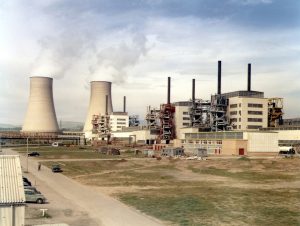
Photo: Calder Hall nuclear power station soon after opening, via Wikimedia Commons. Public domain.